

The Hidden Neuroplasticity Secret to Manifesting Your Goals
How to bridge the gap to your goals by rewriting your internal software: a guide to deep "whys," identity habits, curated inputs, and an ecosystem built for growth.

A lot of people think “manifesting” is just sitting back, closing your eyes, and waiting for the universe to drop a gift-wrapped package at your door.
If you’ve been following my journey here in Sicily, you know I adore the romantic side of life. I believe in the magic of a seaside sunset and the power of a vision board, but I’ve also learned a hard truth: manifestation without discipline is just a daydream.
To hit the ambitious milestones I’ve set for my life and this publication I had to literally rewrite my mental software.
I’m using neuroplasticity, the brain’s literal ability to reorganize itself, to become the version of myself that success actually feels comfortable with.
Here what I’m doing to reprogram my mind and become the person capable of holding the success I’m calling in.
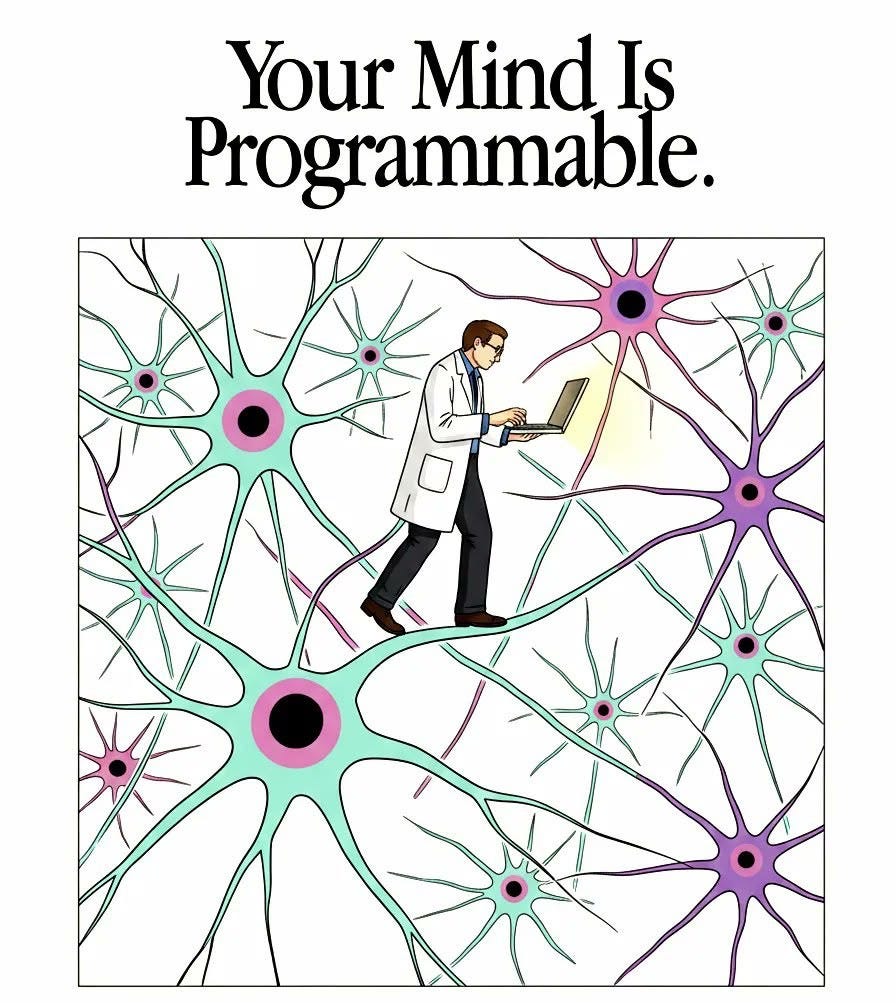
The “5-Why” Deep Dive: Finding the Fuel
Most of us fail at our goals not because we lack willpower, but because our goals are “surface-level.”
We tell ourselves we want 5,000 subscribers, a $10k month, or a perfect morning routine because that’s what the “hustle culture” blueprint suggests. But your brain doesn’t get fired up by numbers or aesthetics. To your subconscious, “1,000 subscribers” is just a cold, abstract digit. It doesn’t trigger dopamine, and it certainly doesn’t sustain you when you’re tired at 6:00 AM.
To rewrite my mind I had to start digging for my “Core Why.”
When I committed to Feeling Pink, it wasn’t just about “writing.” If it were just about writing, I could do that in my private journal. It was the challenge of building a digital empire from a quiet, sun-soaked town in Sicily, proving that location is no longer a limit to impact. It was about creating a roadmap for others who feel stuck in a life that doesn’t fit them.
If you want to manifest a goal, you have to find the version of it that makes your heart race. Take your goal and ask “Why?” five times, stripping away the layers like an onion.
1. I want to be a Substack Bestseller. Why? Because I want my work to be seen and validated.
2. Why do you want your work to be seen? Because I want to know that my ideas have value and can help people.
3. Why is it important to help people with your ideas? Because I want to build a creative career based on my unique perspective.
4. Why do you want a career based on your own perspective? Because I’ve spent too long feeling like I have to “dim my light” to fit into traditional roles.
5. Why is it vital to stop dimming your light? Because I want to feel truly free and secure in my own skin, knowing I can provide for my future self by being exactly who I am.
That 5th “Why” is your fuel.
Notice the shift? We went from a cold number (1,000 subscribers) to a visceral human need (Freedom and Self-Actualization).
When you hit that emotional response, the one that might even make you feel a little bit choked up, you’ve found your anchor. This is the “internal software” that keeps you disciplined when the “aesthetic” of the work wears off and when the “likes” aren’t coming in: You keep going for the freedom.
Tip: Write your 5th “Why” on a Post-it note and stick it to your laptop. Your brain will stop seeing your tasks as “work” and start seeing them as the literal keys to your liberation. (If you do it please drop your photo down below I’d love to see your 5th why)
Identity comes before the Result
The secret to discipline isn’t about white-knuckling your way through tasks you hate; it’s about changing the story of who you are.
Most people operate on a “Have-Do-Be” model: “If I have 10,000 subscribers, I will do the work of a professional writer, and then I will be a successful creator.”
But neuroplasticity works in the exact opposite direction. You have to Be-Do-Have. You must adopt the identity first so that the actions feel natural, eventually leading to the results.
Instead of saying, “I’m trying to become a consistent writer,” I started telling myself, “I am a consistent writer.”
It sounds subtle, but it changes your entire neuro-chemistry. When you are “trying,” you are giving yourself permission to fail. “Trying” implies an experiment that might not work. But when you adopt an Identity-Based Habit, you tap into the brain’s need for cognitive consistency. If you believe you are a runner, you don’t debate whether you feel like hitting the pavement; you go because that’s simply what a runner does.
To manifest my goals here, I had to stop seeing myself as a girl “giving it a go” or a hobbyist playing with a newsletter. I had to step into the shoes of the Founder of a Media Space.
Every day I ask myself: “What would the version of Lux who already is a Substack Bestseller?”
She wouldn’t procrastinate on her draft: She knows her audience is waiting and she respects their time.
She would obsess over the details: She understands that her brand is built on the excellence of her curation.
Identify the gap between who you are today and the person who has already achieved your goal.
If your goal is to be a successful entrepreneur, stop asking, “How do I make money?” and start asking, “How does a successful entrepreneur manage their focus?”
It’s not about being delusional, when you act as the person you want to become, you are bridging the gap between your current circumstances and your goal by proving to yourself, one action at a time, that you are already that person.
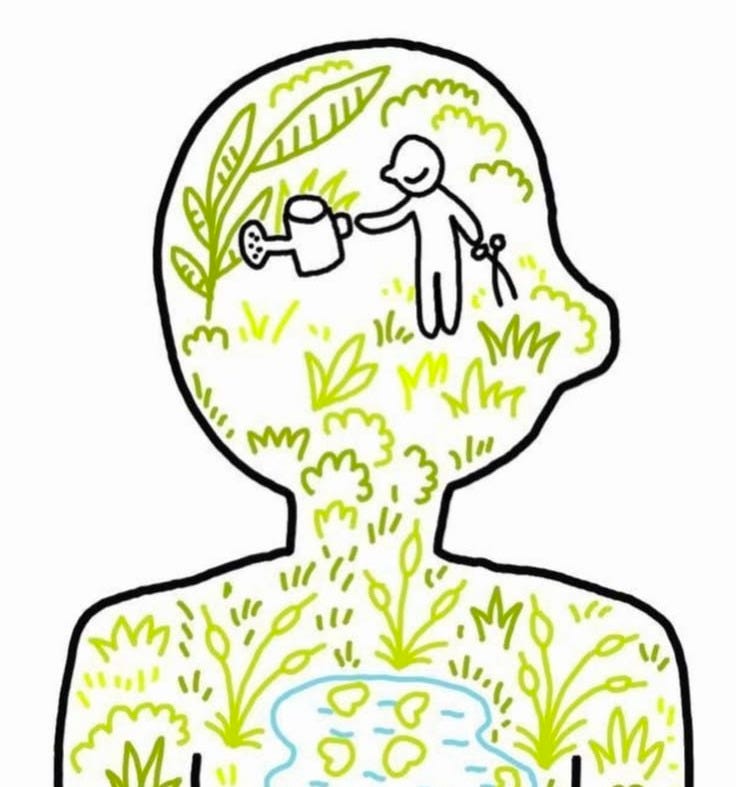
The Ecosystem of Excellence: Designing Choice and Curation
If you rely on willpower to manifest your goals, you’ve already lost.
Willpower is a finite chemical resource. It’s high in the morning when you’re sipping your coffee, but by 6:00 PM, after a day of decisions, stress, and “life,” it’s depleted.
This requires a two-pronged approach: engineering your physical environment to save your energy, and curating your mental environment to direct your focus.
Your brain is biologically wired to take the easiest route. If your phone is next to you, “scrolling” is the path of least resistance. To win, you must engineer friction.
Here’s what I do:
The 10-Minute Gateway: If a task feels like a mountain, your brain will trigger a “threat” response and shut down. I bypass this by committing to just 10 minutes. This lowers the “entry friction.” Once the dopamine of starting kicks in, the flow state takes over.
Environmental Triggers: I set up my workspace the night before. A clean desk, my notebook open to a fresh page, and my water glass filled, when your space it’s clean your mind it’s clear but it’s also a visual cue that tells my subconscious: “The decision has already been made.”
Once your physical space is set, you must protect the “software” running inside it. You cannot manifest a high-level life if your mind is fed on “mental junk food.” Your Reticular Activating System (RAS), the brain’s built-in filter, is like a search engine. It will find exactly what you tell it to look for.
If you feed your RAS with mindless scrolling, comparison, and “rage-bait” news, it will filter your reality to show you more reasons to feel “behind” or angry. But when you become ruthless with your inputs, you reprogram the search engine.
Look at your day through the lens of a “Designer,” not a “Worker.”
Identify your biggest “Friction Point”: What is the one thing that always stops you from starting? (Is it a messy desk? A distracting app? Lack of a plan?) Fix it.
Audit your Top 5 Inputs: Who are the five creators or people you listen to most? Do they reflect your future, or your past?
When you align your physical space with your mental diet, you create a “container” where success it’s inevitable.
Rewriting your mind is “dirty” work. It’s tiring, and it requires you to look in the mirror and admit where you’ve been playing small. But it’s the only way to start being the director of your own life.
I’m building my dream life one habit at a time and you can start doing the same, right now.
Every Monday and Friday, I’m here to show you the behind-the-scenes, the mindset blocks, and the real-time process of building a dream life from scratch. If you’re trying to do the same don’t do it alone and join our community.
I’d love to hear from you: If you were to act as the “future” version of yourself for just one day, what is the very first thing you would change about your morning routine? Let’s talk in the comments.
As always,
hope this helps,
Lux
Feeling Pink is an independent publication, written with love from a small seaside town in Sicily 🇮🇹. If you enjoy this content and want to support my work, consider upgrading to a paid subscription.
This is a great article, and that have-do-be mindset we want, but having to do the be-do-have is super tough! I think if I were the "future" version of myself, I would eliminate all scrolling before I start work! I have gotten better, but still do a little scrolling in the morning (which I know isn't helpful)!.
Especially starting out, our minds are frequently raided by doubts, uncertainties and things that sap at our confidence. If left unchecked, these can reinforce neural pathways that turn into toxic and reflexive self-defeating talk. Your framework for Identity-Based Habits is a great moment to start challenging these things intentionally before they become a problem. Reinforcing your positive identity will power up your efforts while addressing negative threats will lower the barriers you have to break through: "As a competent practitioner, this is how I will deal with the adversity I am facing."